> ## Documentation Index
> Fetch the complete documentation index at: https://docs.nemu.com.br/llms.txt
> Use this file to discover all available pages before exploring further.
# Introduction
> This document provides an overview of Nemu's SDKs system, explaining how the tracking, attribution, and journey unification process works between mobile and web applications.
# Overview
The **Nemu SDKs** were developed to enable mobile applications to perform **complete tracking of the user journey**, from the source of the first access to relevant events such as login, engagement, and sales.
Through the SDKs, Nemu is able to collect, persist, and correlate user source and behavior information, ensuring **reliable attribution**, **journey continuity**, and **integration across multiple environments** (Web and App).
The SDKs are available in different languages and mobile platforms, respecting the technical particularities, privacy limitations, and policies of each ecosystem.
***
## SDK objectives
The main objective of the Nemu SDK is to solve common challenges in mobile environments, such as:
* Loss of source between clicks, installations, and app openings
* Difficulty in unifying journeys between **Web → App** and **App → Web**
* Limitations of cookies and traditional identifiers on mobile devices
* Privacy restrictions imposed by operating systems and app stores
The SDK acts as the **data collection and persistence layer**, while attribution models and analyses are applied later on the Nemu platform.
***
## Key features
The Nemu SDKs offer, among others, the following features:
* **Creation and retrieval of journey sessions**\
Each user is associated with a tracking session that represents their browsing and conversion journey.
* **User identification by UID**\
Allows associating sessions and events with an identifier defined by the application (e.g., logged-in user ID), enabling data consolidation across accesses.
* **Traffic source attribution**\
Capture and persistence of UTMs coming from:
* Direct deep links
* Installations via app store (install attribution)
* Deferred deep links
* **Source persistence across sessions**\
Ensures that the attributed source can be retrieved even after closing and reopening the application.
* **Integration between Web and App**\
Enables the **automatic linking of journeys** between Web ←→ App environments through the use of UID, maintaining attribution continuity.
***
## How the SDK fits into the Nemu ecosystem
The SDK is responsible **exclusively for collecting and sending data**.\
The application of business rules and attribution models occurs on the Nemu platform.
In simplified terms:
1. The SDK collects source, session, and user information in the application
2. This data is sent securely to Nemu
3. The Nemu platform processes:
* Attribution models (Last Click, First Click, Assisted, etc.)
* Consolidation between Web and App
* Reports and dashboards
The SDK does not define the final attribution model. It ensures the quality and integrity
of the data needed for attribution to be applied correctly on the platform.
***
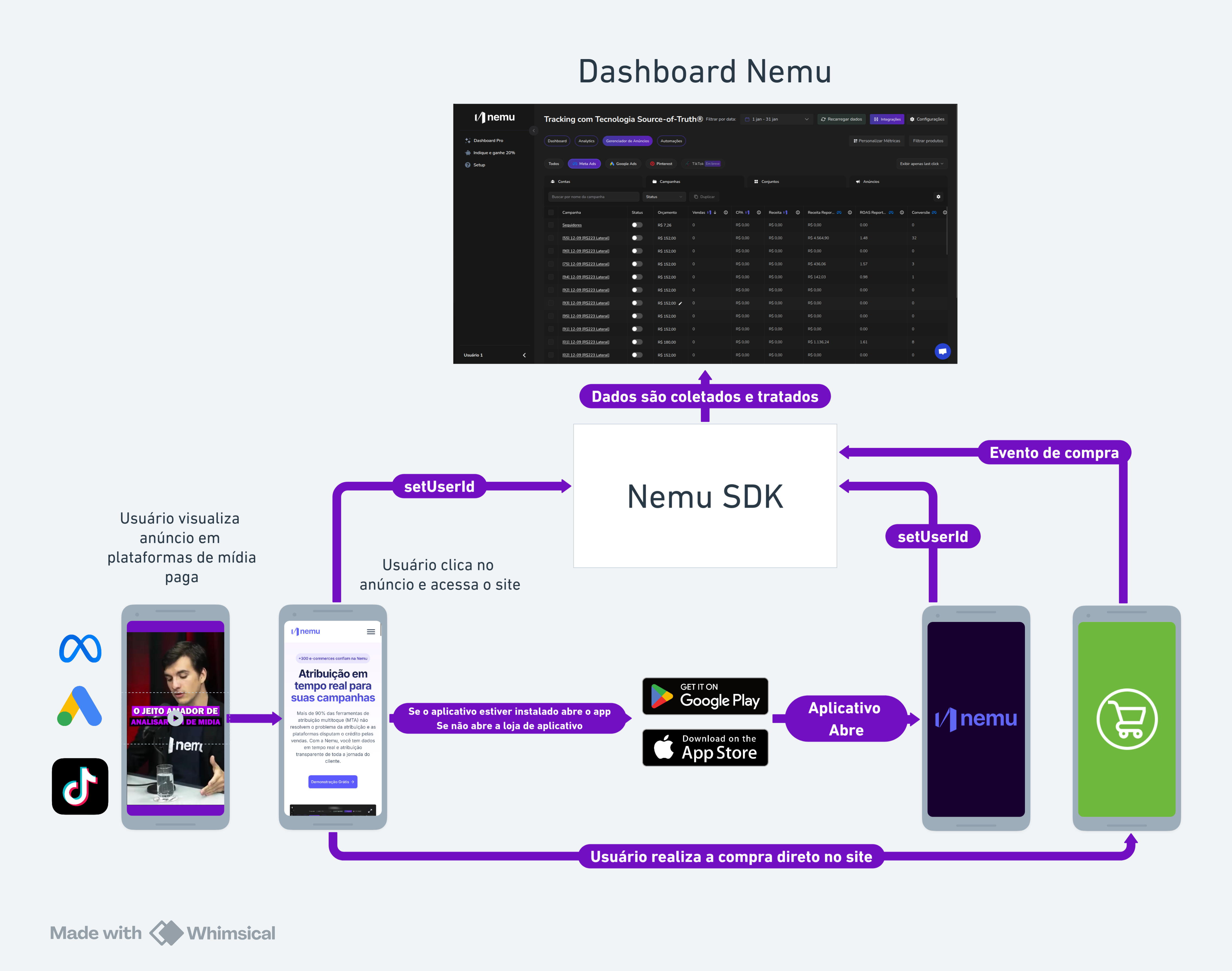
## Summary of how the SDK works
In summary, the SDK's operation flow follows the steps below:
1. The application initializes the SDK
2. The SDK captures the user's source (deep link, installation, or deferred deep link)
3. A tracking session is created or retrieved
4. The user's UID is associated when available
5. The UTMs and session information become available for events and sales
6. The data is sent to Nemu for processing and attribution
 ***
## Compatibility and expectations
The Nemu SDKs are designed to:
* Work in **Android and iOS** environments
* Respect the platforms' privacy policies
* Operate correctly even with identifier limitations
* Maintain compatibility with legacy applications and enterprise environments
Some limitations may exist depending on the platform, operating system version, and permissions granted by the user. These particularities are detailed in the specific documentation for each SDK.
***
## Next steps
After understanding the general operation of Nemu's SDKs system, we recommend proceeding to:
* The specific documentation for your platform's SDK
* The initial configuration sections
* The integration testing and validation guides
Each specific documentation goes deeper into the technical details needed for a correct and secure integration.
***
## Compatibility and expectations
The Nemu SDKs are designed to:
* Work in **Android and iOS** environments
* Respect the platforms' privacy policies
* Operate correctly even with identifier limitations
* Maintain compatibility with legacy applications and enterprise environments
Some limitations may exist depending on the platform, operating system version, and permissions granted by the user. These particularities are detailed in the specific documentation for each SDK.
***
## Next steps
After understanding the general operation of Nemu's SDKs system, we recommend proceeding to:
* The specific documentation for your platform's SDK
* The initial configuration sections
* The integration testing and validation guides
Each specific documentation goes deeper into the technical details needed for a correct and secure integration.